
_svg.webp)

Evidence | What People Experience
Independent reviews, client experiences and professional recommendations supporting a different model of financial planning.
Don’t just take our word for it. Follow the evidence.
The Academy of Life Planning is built around a different idea of financial planning.
We believe good planning should help people understand, choose and act with greater confidence.
It should begin with the life being funded, not the financial product being sold.
Technology should increase human capability, not replace human judgement.
And professional support should be available when it is most useful — particularly during periods of complexity, stress or change — without requiring people to surrender permanent control of their money.
Those are claims.
This page brings together independent reviews, client experiences, professional recommendations and published commentary that provide evidence supporting them.
No single testimonial proves a model. But when different people, in different circumstances, repeatedly describe similar outcomes, a pattern begins to emerge.
Evidence that people become more capable
“Without feeling pressured or taking the decisions away from us”
Deborah S — Retirement planning client
5-star Google and Trustpilot review — July 2026
“Steve's ‘Second Brain Sessions’ and the Academy OS tools have been invaluable, helping us understand different retirement options and make informed decisions about our future.
Navigator allowed us to explore different scenarios to understand the potential impact of our choices, while Steve's guidance helped us feel confident in our decision making without feeling pressured or taking the decisions away from us.
We now feel much more informed and positive for the future.”
This experience provides particularly clear evidence of the Academy model in practice:
AI-supported exploration → human second-brain support → client-retained decision-making.
What this supports: greater understanding • scenario exploration • informed choice • confidence • retained agency
“Our regular meetings empowered me to make decisions”
Lisa Jackson — Lancing, England
Lisa came to Steve following bereavement and describes needing patient support at a time when financial decisions felt especially difficult.
“Our regular meetings ‘forced’ me to take action and empowered me to make decisions about my financial planning.”
In her later Google review she added:
“All my finances are well organised now and I did not have to sign over 5% or 1% of my life savings in order to get the advice I needed.”
Lisa's experience supports two important propositions: that people can receive expert support during a difficult transition while remaining the decision-maker, and that useful financial planning does not necessarily require a permanent percentage-based relationship.
What this supports: episodic support • bereavement support • financial organisation • client control • alternative fee models

“For the first time, I truly saw who I am”
John H — Virginia, USA
“Your life planning approach goes far beyond financial planning. Yesterday's session was a life-changing experience.
For the first time, I truly saw who I am, thanks to the exercises we did together.
It's not just about money — it's about understanding your true self and finding your purpose.”
John's experience illustrates the Academy's whole-person approach: understanding the person and the life first, then considering the role money should play within it.
What this supports: purpose • self-understanding • whole-person planning • life-first decision-making
Evidence that planning can turn aspiration into action
From life plan to a new way of living
Binny Shah-Patel
Binny first encountered life planning while working in banking.
She describes how it helped her think ahead, visualise the life she wanted and become more alert to opportunities that could move her towards it.
That subsequently included developing a side business, moving into freelance work and achieving property goals she had previously visualised.
“Life planning has been an essential tool to building the life I wanted and imagined and a big thanks to Steve for helping plant that seed to change my mindset.”
The significance is not that planning predicted each outcome.
It helped create greater intentionality around what Binny wanted, which influenced the choices and opportunities she pursued afterwards.
What this supports: intentional living • mindset change • recognising opportunities • long-term agency

A farm three years earlier than planned
Joanne Corbishley
Joanne and her family discussed their ambition to own a farm as part of their planning.
Their original expectation was to achieve the goal by around 2024.
They subsequently had an offer accepted on a 15-acre farm and expected to move during 2021.
“I just wanted to thank you for all of your help and the plans that you did for us that inspired us to work towards realising our dream.”
The planning did not create the opportunity. It helped turn a distant aspiration into something concrete enough to act upon.
What this supports: goal clarity • action planning • life-first outcomes • turning aspirations into decisions

Life savings lost in an offshore pension scam
Gary Wrighton
Steve was first introduced to us by a third party and he was sympathetic towards our plight. He never condemned the action we had previously taken, but supported our case in a dangerous world of financial fraud and deception.
Steve guided us through a minefield of deceit and lies and was able to provide advice that improved our case for the better. His knowledge of the financial market is second to none and would recommend his services to all.
I now have legal support as my claim finally has foundation based on facts. Our lawyer was impressed with our knowledge of a complicated market, but it was Steve behind the scenes that had been the reason.
We will always be grateful to Steve as his support helped pull us through some very dark times. Thanks again Steve for your very kind support.

Evidence that AI can increase agency rather than replace it
The Academy does not use AI to make people's decisions for them.
Its purpose is to increase people's ability to understand their circumstances, explore alternatives and prepare for better conversations.
The Deborah S retirement review provides direct evidence of this principle in practice:
“Navigator allowed us to explore different scenarios... while Steve's guidance helped us feel confident in our decision making without feeling pressured or taking the decisions away from us.”
Independent Trustpilot reviewer Graham Francis similarly described the Academy's use of AI as strengthening its ability to help people who may previously have been excluded from traditional financial services.
The intended model is simple:
Your brain. AI. A human second brain when needed.
Each complements the others.
None should unnecessarily replace the client's own judgement.
Evidence that professional support can be episodic
People do not necessarily need an adviser permanently standing between them and their money.
Sometimes they need an experienced person beside them for a particular decision, transition or problem.
Trustpilot reviewer Paul Birch described receiving practical and impartial support when dealing with government bodies and regulated institutions in connection with pension scams.
Lisa Jackson describes receiving the help she needed after bereavement without committing a percentage of her life savings to an ongoing adviser relationship.
The Deborah S retirement review describes a combination of digital tools and follow-up conversations that enabled the clients themselves to reach their decisions.
Together, these experiences support an alternative model:
Routine capability can increasingly sit with the individual. Human expertise becomes especially valuable during complexity, stress and change.
Evidence that financial planning can begin with life rather than products
“Life beyond just the numbers”
George Agan — Chartered Financial Planner
“Steve's coaching and GAME Plan process has been extremely helpful in clarifying my goals as a Financial Planner.
Steve's focus is on life beyond just the numbers and I found his insight and approach very useful in planning a more holistic approach to building wealth.”
George is the founder of YouTube channel Creator Finance.

“A plan for their life and then... a relevant financial plan”
Gary Arthurs — Founder, A Life Well Planned
Gary describes the GAME Plan methodology as helping clients create a plan for their life before supporting it with the appropriate financial plan.
He also highlights another important distinction: people's resources are not limited to their financial assets.
What this supports: life before money • whole-person wealth • structured planning • resources beyond financial capital

Evidence that professionals can practise differently
“Clients don't need to hand over control”
Geoff Dyckes — Registered Life Planner®
“What makes Steve stand out is his belief that clients don't need to hand over control of their investments to get real value from a planner.
That's a radical idea in an industry built on assets under management and he's right.”
Geoff goes on to describe the planner's role as supporting, guiding and providing an empathetic ear when life becomes complicated.
That closely reflects the Academy's current professional model: the planner beside the client, rather than permanently between the client and their money.

“The power of not selling products”
Emma Wright — Financial Empowerment Coach and Wealth Strategist
“Working with Steve has been transformational. It gave me the confidence I needed to supercharge my independent financial planning, and to see the power of not selling products and instead empowering financial activation.”
Emma's experience provides professional evidence that a planner can redefine their value around planning and empowerment rather than product distribution.
What this supports: professional transformation • product-free planning • planner confidence • client empowerment

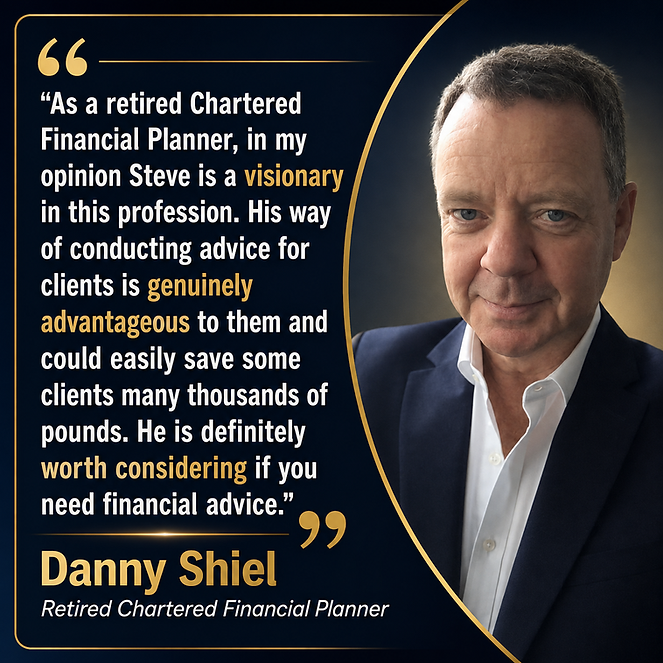
Could easily save clients many thousands
Aug 2026 — Danny Shiel
Harrogate, North Yorkshire
“A calmer, fairer, and more sustainable way to serve”
Greg H — Financial Planner
Greg describes leaving financial services because of the stress associated with the conventional model and later discovering a different way to practise.
“As a holistic, fee-paying financial planner, I can support clients without recommending specific products or investments...
Client feedback has been overwhelmingly positive. It feels like a calmer, fairer, and more sustainable way to serve — excellent planning at a fair price.”
His experience provides evidence of the transition from intermediary-led advice towards a planning-led professional model.
What this supports: non-intermediating planning • professional sustainability • fair pricing • client response

Independent professional commentary
Basically, you’ll do everything except recommend a product for people at the end.
Brett Davidson — FP Advance
Financial planning consultant Brett Davidson examined Steve Conley's non-intermediating planning model after speaking with him directly.
He described the proposition as potentially disruptive and considered whether consumers might increasingly prefer to separate financial planning from product selection.
“Steve Conley is on a mission to change the advice landscape and I don't write these words lightly.”
Brett also challenged parts of Steve's analysis, making the article particularly useful as independent professional scrutiny rather than simple endorsement.

Steve Conley’s transformative guidance brings clarity, purpose, and life-changing impact—highly recommended.
Feb 2025 — Andy Agathangelou
Founder of the Transparency Taskforce
“I’ve known Steve Conley for years and I’ve always trusted him and rated his abilities - I think he’s great. But in recent months I have personally benefited from his tremendous skills as a facilitator, a coach, a life planner.
We have been meeting on Zoom weekly and through a remarkably effective step-by-step process Steve has helped me to put my own future plans and that of the TTF into focus.
My planning is so much better now than it ever has been - I have an even greater sense of clarity of purpose than I have ever had before; it feels great and I want others to have a chance to understand Steve’s process.
During one of our conversations it dawned on me that what Steve does could be particularly beneficial to people who are facing real hardship; be that financially and/or emotionally, as a direct consequence of becoming a victim.
Steve was happy to run this special meeting for TTF people so that they might get a feel for how beneficial values-based, holistic planning can be.
I am enthusiastically and unashamedly wanting to promote this event as best as I possibly can, because my instincts are that some people will find it, and any future related events that we do, helpful in a deep-down, heart and soul way. Be open minded and attend, please - I highly recommend it.”
- Andy Agathangelou.

You understand things quickly and make things happen. But most of all you see into the future...
George Kinder — Founder of Life Planning
George Kinder has described Steve as someone with considerable vision, knowledge and an ability to understand complex systems and make things happen.
“Don’t have any idea about implementation or how, but you really should be running one of these banks. You’re a man of immense vision, with knowledge of all the pieces and pockets of community and profit that are necessary to make a bank thrive. You understand things quickly and make things happen. But most of all you see into the future, much as Steve Jobs did, and are as passionate and dedicated to making an organisation both ‘aesthetically beautiful’ and brilliantly profitable, understanding that the key is the customer, delivering something of magnificent value for them. There aren’t many like you, and if this is your career, you should be at the top.”
His endorsement adds independent professional evidence of Steve's longstanding commitment to customer-centred innovation and life planning.

A model developed in public over more than a decade
The Academy of Life Planning's current approach to human agency, whole-person wealth, non-intermediation, AI-supported capability and episodic human support did not appear overnight.
These ideas have been developed publicly through industry writing, interviews and professional debate over more than a decade.
The language has evolved. The underlying direction has remained remarkably consistent: start with the person, widen access to planning, reduce unnecessary dependency, use technology to increase capability, and keep the client at the centre of the decision.
2014 — Life planning and the advice gap
Citywire — Why life planners must join forces to close the advice gap
An early argument that life planning should not remain a niche service for a small number of wealthy clients, but could help widen access to meaningful financial planning.
2020 — Digitising life planning
Citywire — How I digitised a life planning proposition
Published as the pandemic forced financial professionals to rethink how conversation-led planning could be delivered remotely.
The article documented an early attempt to translate life planning into a digital environment without losing the questioning, reflection and human interaction at its heart.
2020 — Why advisers never have to sell products again
The Academy of Life Planning’s Steve Conley set out a bold vision for the future of the profession at our Money Marketing Interactive conference. Relive his keynote presentation below. MMI 2020: Netflix model could open up financial planning.
[Relive keynote presentation.]
2021 — Separating planning from product intermediation
Money Marketing — Can unregulated planners help plug the advice gap?
This article made an important distinction between financial planning and financial intermediation.
Planning helps people establish their goals, understand their circumstances and identify strategies. Intermediation involves recommending or arranging specific financial products.
That distinction became a foundation of the Academy's later non-intermediating planning model.
2021 — Whole-person planning
Money Marketing — The rise of whole-person planning
The argument widened further: financial planning should not focus only on financial assets.
Health, work, purpose, relationships, capability and the wider life being funded all influence financial wellbeing.
2022 — Incentives and client outcomes
Money Marketing — Do incentives limit client outcomes?
This article examined a structural question that remains central to the Academy's work:
How does the way financial professionals are paid influence the solutions clients are encouraged to choose?
The Academy's response has increasingly been to separate planning value from product distribution wherever possible.
2023 — AI changes the planner's role
Money Marketing — Don't even try to compete with AI
Before generative AI became embedded in everyday financial planning, the argument was already being made that machines would increasingly perform mechanistic planning tasks.
The implication was not that humans would become irrelevant.
It was that human value would move towards judgement, empathy, interpretation, challenge and support.
2023 — Non-intermediating planning becomes explicit
Money Marketing — Ever thought about becoming a non-intermediating planner?
This article developed the professional alternative more clearly: planners could provide meaningful financial planning without necessarily becoming responsible for selecting and intermediating financial products.
2024 — Planner and adviser are not the same thing
Money Marketing — Adviser or planner? There's a crucial difference — and fees should reflect that
The distinction between financial planning and financial advice became increasingly important.
Planning is concerned with understanding a person's life, resources, priorities and strategy.
Advice on specific financial products is a different activity.
The Academy's model increasingly separates the two.
Independent media coverage of the emerging model
The model has also been examined outside the Academy's own publishing.
“There is not an advice gap, just a planning gap”
FT Adviser
In an interview with FT Adviser, Steve Conley argued that many people excluded from traditional advice do not necessarily need somebody permanently managing their money.
They need access to financial planning, education, practical tools and professional support when circumstances become difficult.
The article captured several ideas that now sit at the centre of the Academy model:
Empowerment, not delegation.
People can often manage their own financial affairs when they have the right tools and understanding.
One-to-one professional support becomes particularly valuable during periods of change, complexity or stress.
Financial planning can be separated from product selling.
And proper financial planning begins with the person before it begins with the money.
[Read the FT Adviser article.]
Is there merit in separating financial advice and financial planning?
What happens when the ideas and the evidence meet?
Published ideas are not enough.
A philosophy becomes more interesting when people begin to experience it in practice.
Across the evidence on this page, three different forms of corroboration begin to converge.
The published work shows what the Academy has been arguing.
Professional planners show how parts of the model are being put into practice.
Clients and users describe what they experience when they use it.
That allows us to compare some of the Academy's central claims with the evidence gathered around them.
Claim: people can retain control of their own decisions
Deborah S describes using Navigator to explore retirement scenarios while Steve's support helped them make decisions with greater confidence “without feeling pressured or taking the decisions away from us”.
Lisa Jackson describes becoming more organised and empowered following bereavement without having to commit a percentage of her life savings to an ongoing adviser relationship.
Geoff Dyckes describes the same principle from the planner's perspective: clients do not need to surrender control of their investments to receive genuine value from a financial planner.
The recurring pattern is support without unnecessary substitution.
Claim: planning can be separated from product intermediation
Emma Wright describes discovering “the power of not selling products and instead empowering financial activation”.
Greg H describes a calmer, fairer and more sustainable way of serving clients through holistic fee-paying planning without recommending specific products.
Martin Turbin describes Steve's work in advancing non-intermediated financial advice.
Brett Davidson independently examined the concept and described its potentially disruptive implications for conventional advice models.
The evidence suggests that professional value can exist before, around and sometimes entirely apart from product intermediation.
Claim: AI can increase capability without replacing human judgement
The Academy has long argued that technology should perform more of the mechanistic work of planning while humans concentrate on the parts requiring judgement, empathy and context.
Deborah S provides practical evidence of that model: Academy OS tools helped them explore alternatives, while human conversation helped them interpret those alternatives and make their own decision.
Graham Francis independently describes AI as making the Academy's work more powerful and widening access for people underserved by traditional financial services.
AI becomes a capability layer, not a substitute decision-maker.
Claim: human support can be episodic
Lisa needed support during bereavement.
D S needed support while making retirement decisions.
Paul Birch sought experienced help while dealing with government agencies and regulated institutions in relation to pension scams.
The common feature is not permanent dependency.
It is access to knowledgeable human support when circumstances become unusually difficult.
Routine capability can sit with the individual. Human expertise can be called upon when complexity, stress or change makes a second brain valuable.
Claim: financial planning should begin with life
John H describes life planning as helping him understand himself and his purpose.
Binny Shah-Patel describes life planning changing the way she thought about her future and the opportunities she pursued.
Joanne Corbishley describes planning helping her family turn the ambition of owning a farm into practical action.
Gary Arthurs describes GAME Plan as creating the plan for the client's life first and then supporting it with an appropriate financial plan.
The published work on whole-person planning, wellbeing and human capital shows the same idea developing over time.
Money is not the destination. It is one of the resources available to support the life being created.
What does the body of evidence suggest?
No individual review, recommendation, case study or article proves the Academy's entire philosophy.
Nor should it.
The more useful question is whether independent experiences repeatedly point in similar directions.
Across different people, different years and different forms of evidence, several patterns recur.
People report greater clarity
They describe understanding their circumstances, priorities and options more clearly.
People report greater confidence
They describe feeling better equipped to make important decisions and act upon them.
Clients can remain active participants
Support does not necessarily require handing over permanent control of financial decisions or assets.
Planning becomes life-first
The conversation moves beyond “Which financial product should I buy?” towards “What am I trying to do with my life, and what resources will help me do it?”
Technology can widen capability
Digital tools and AI can make planning knowledge, scenario testing and financial education more accessible.
Human expertise still matters
Particularly when circumstances are complex, emotionally difficult, unfamiliar or changing quickly.
Professionals can practise differently
Planners describe building models around planning, coaching, education, empowerment and episodic support rather than relying exclusively on product distribution or assets under management.
The underlying philosophy has remained consistent
Earlier professional recommendations describe customer-centred design and life planning.
Later published work develops whole-person wealth, non-intermediation and digital planning.
Current reviews describe agency, AI-supported decision-making and episodic human support.
The terminology has changed because the technology and the environment have changed.
The underlying question has remained the same:
How can financial planning leave the person stronger?
A different model of financial planning
The evidence collected here supports a model in which:
the person remains the principal decision-maker;
AI increases access to information, modelling and reflection;
a human professional provides judgement, challenge and reassurance when needed;
and financial planning exists to support the life being lived, rather than becoming an end in itself.
This is the direction the Academy of Life Planning is working towards.
Advice out. Agency in.
Explore the evidence